Non-Disclosure Agreement: only non-proprietary aspects of my work at Planet Labs are discussed here.
During my summer internship at Planet, I helped mature the Pelican Block II program from PDR through CDR by implementing an analysis-driven risk posture focused on continous V&V. This involved deep analytical dives to mitigate risks before they hit flight hardware. These projects taught me how to define the trade space for critical subsystems and manage systems-level margins, providing a deep appreciation for how overall performance emerges from the complex interplay of dozens of interdependent variables.
I developed a comprehensive spacecraft power and drag simulation framework. By synchronizing the simulation with the satellite's true activity schedule and propagated orbital position, the tool evaluated generation profiles against complex constraints such as sun fraction, attitude slews, and GEO relay pointing. This rigorous approach enabled power consumption estimates within a 2% margin of error. Furthermore, by integrating Monte Carlo drag parameters from OpenFOAM, I provided critical data on how GEO pointing implications directly penalize lifetime propellant consumption in LEO.
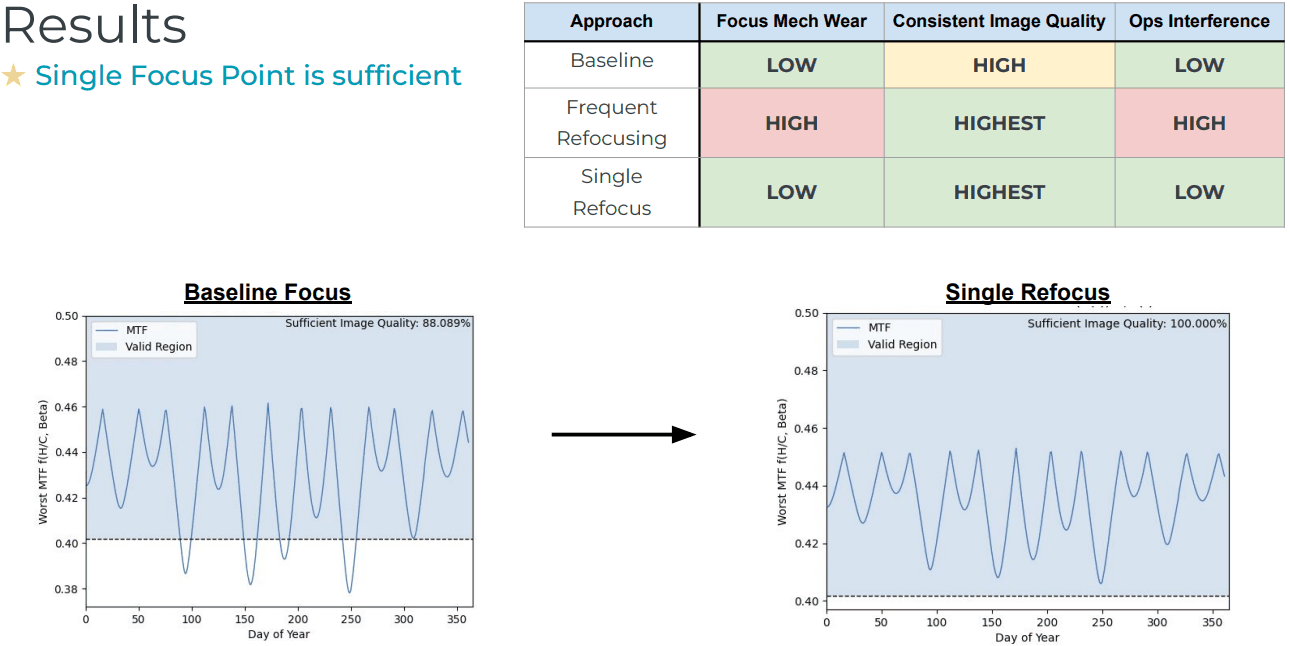
I performed a comprehensive STOP (Structural, Thermal, Optical) analysis for the Pelican Block II spacecraft to accommodate its next-generation payload. By simulating structural and thermal fluctuations in ANSYS Zemax, I correlated environmental changes over the orbital duty cycle to predict optomechanical deformations. This analysis enabled the determination of the optimal focus position, ensuring minimal wavefront error and peak imaging performance across extreme spacecraft temperature gradients.
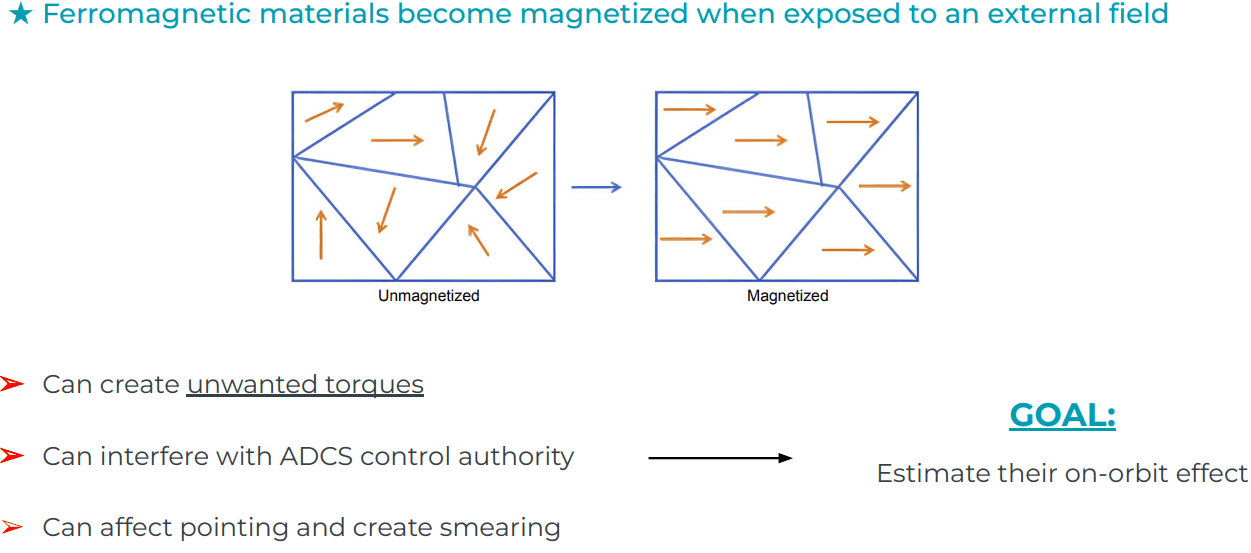
I spearheaded a critical study on un-characterized ferromagnetic materials within the Block II payload. By modeling theoretical fields in FEMM and computing equivalent magnetic dipole moments, I validated that these materials had insignificant impacts on GNC control authority. This analysis ensured high-precision satellite pointing stability during sensitive imaging operations.