For UCSD's Rocket Propulsion Laboratory, I conducted a comprehensive computational analysis of a vortex-cooled rocket engine to determine the feasibility of implementation for high-performance collegiate rocketry.
My work focused on achieving grid independence through quantitative analysis, ensuring that the simulated fluid flow—characterized by high-velocity compressible exhaust - accurately represented physical phenomena without being skewed by mesh resolution.
Mesh Refinement & Convergence Study
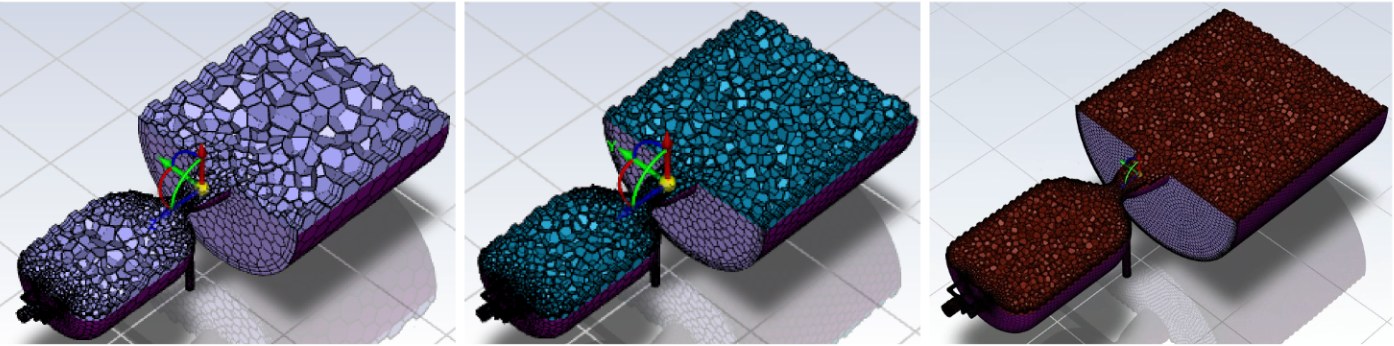
I performed a three-level mesh refinement study using Ansys Fluent, scaling from a coarse 62,000-cell mesh to a fine 371,000-cell polyhedral mesh. By maintaining a consistent grid refinement ratio (r=2), I was able to apply rigorous mathematical validation to the results.
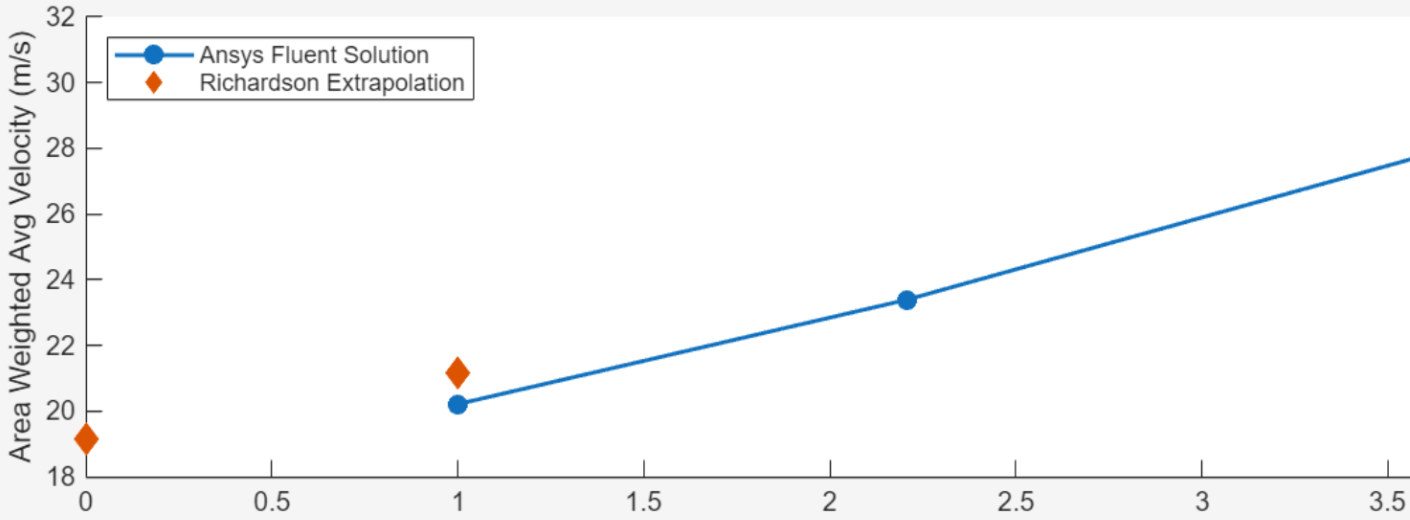
I utilized Richardson Extrapolation to approximate the theoretical "zero-grid-size" solution, providing a benchmark for the maximum velocity (633.7 m/s) and area-weighted average velocity (19.2 m/s).
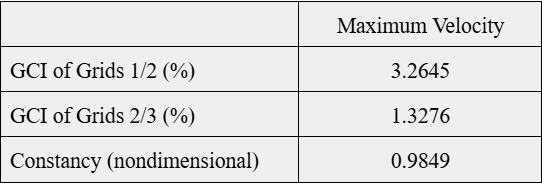
To quantify discretization error, I calculated Roache’s Grid Convergence Index (GCI). The maximum velocity reached the asymptotic range of convergence with a constancy value of 0.9849, successfully validating the grid independence of the simulation.
Flow Physics & Performance Validation
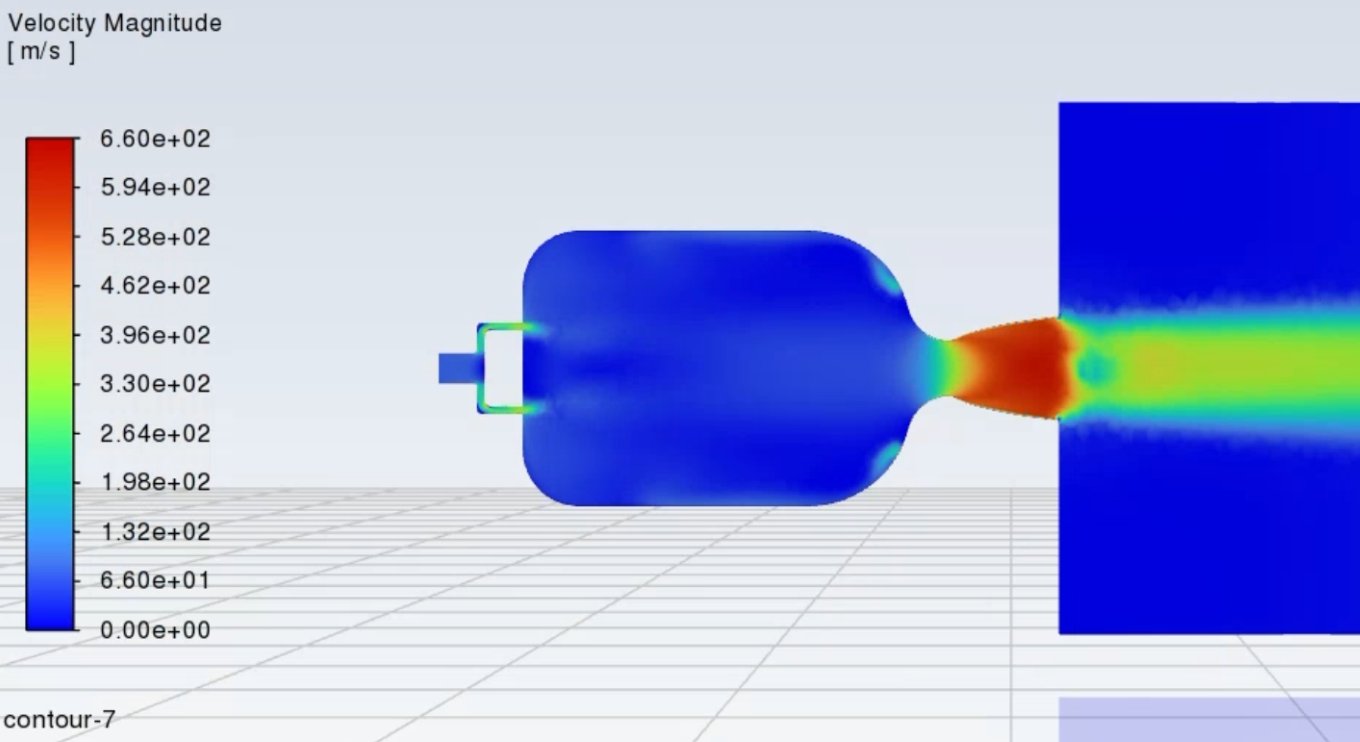
Velocity Magnitude contour exhibiting supersonic flow at the nozzle exit
I modeled the flow as a compressible ideal gas using the k-epsilon turbulence model to capture the effects of turbulent kinetic energy and dissipation. This was critical as exhaust velocities exceeded Mach 0.3 at the nozzle throat and reached design targets of Mach 2.54+.
The analysis identified that while maximum velocity magnitude converged rapidly, area-weighted average velocity at the plenum required finer refinement to reach 5% error thresholds. This insight allowed for a data-driven recommendation on simulation fidelity versus computational cost.